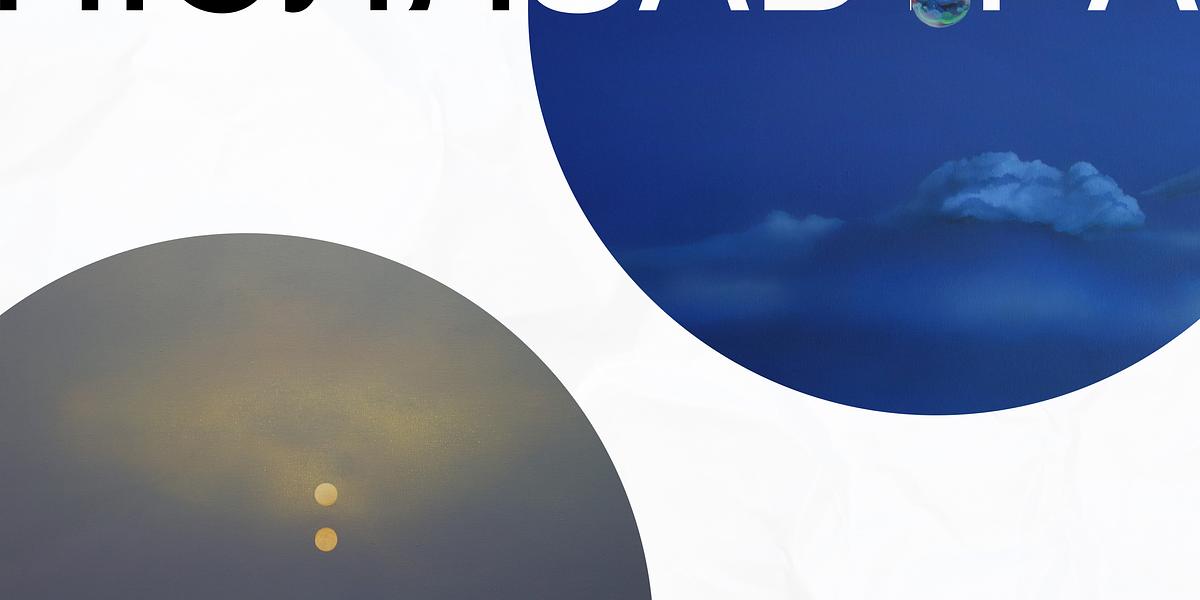
DAY AFTER TOMORROW
2023–ongoing
The Day After Tomorrow is a painting project about the future as a space of possibility. I am interested not in predicting what will happen, but in the human condition when facing the unknown — the moment when the future has not yet taken form, yet can already be sensed as a presence.
The title of the project defines this distance. Tomorrow almost belongs to the present. The day after tomorrow is already a territory of uncertainty. It is close enough for us to imagine, yet distant enough to remain open to different possibilities.
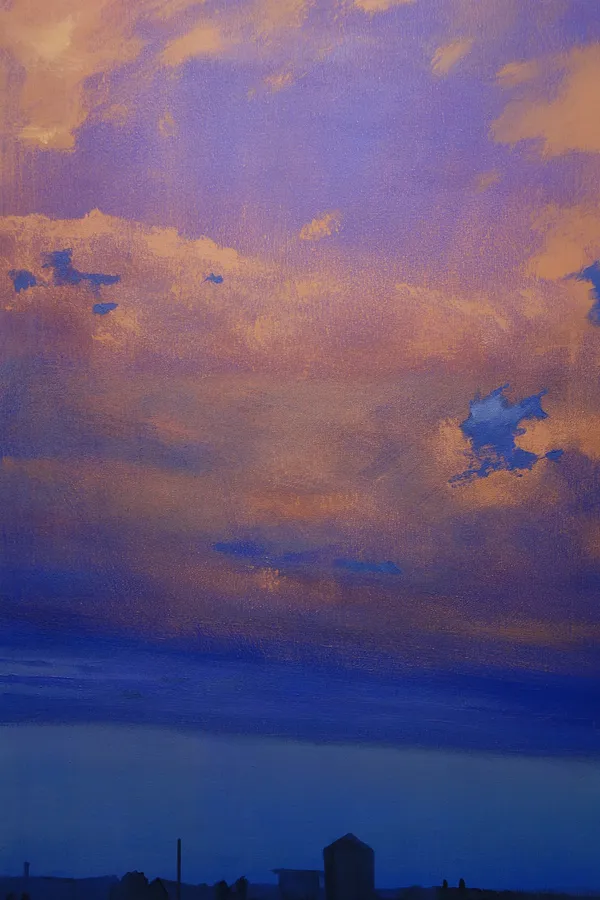
For this reason, the landscape in these works gradually frees itself from any specific place. Sky, horizon, water, light, and a distant line of land create a minimal space in which the possibility of an event becomes more important than the event itself.
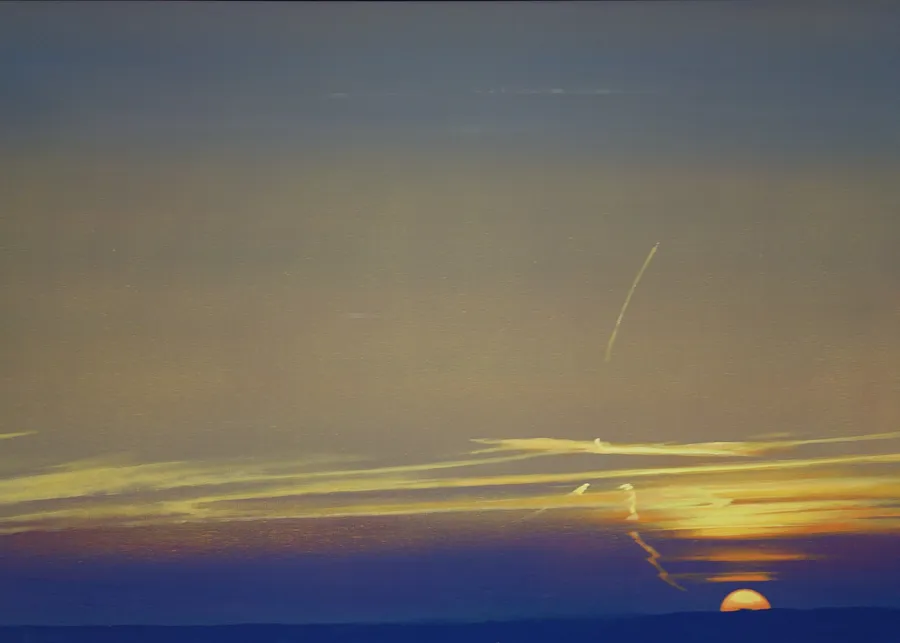
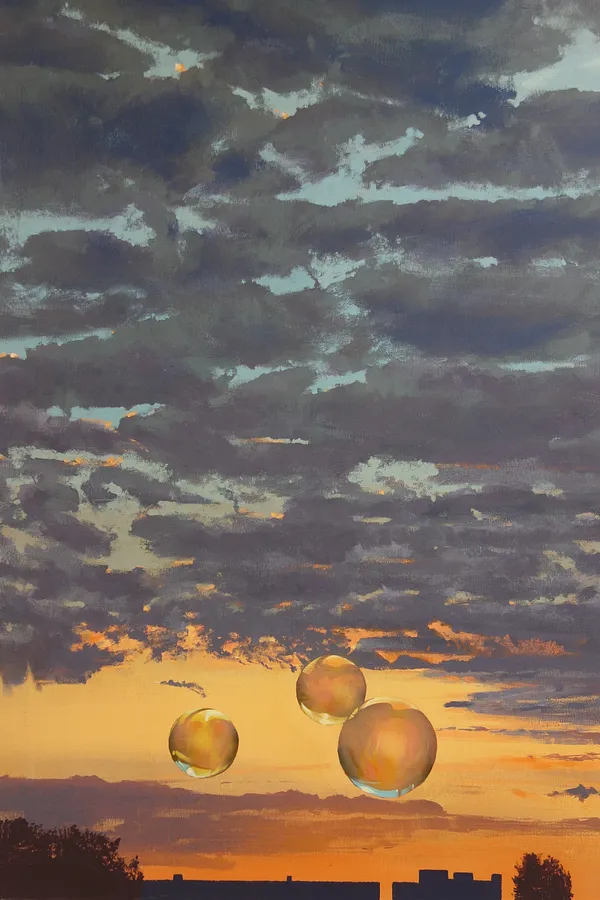
The sky occupies a particular place within the project. It appears not as a background, but as a vast field of uncertainty — a space in which phenomena of light, spheres, double suns, or other images may emerge, disrupting the familiar logic of the landscape.
These elements have no single explanation. A sphere may be perceived as a celestial body, a signal, a concentration of energy, or an unknown object. A double sun may appear as an optical phenomenon, a metaphor for choice, or an image of two possible futures. The real landscape becomes a place where something that does not yet have a definite name can appear.
Light also acquires a different function in The Day After Tomorrow. It no longer serves only to create atmosphere, as it does in Impressions. It becomes a signal — a sign that somewhere beyond the limits of the visible, change has already begun.
Of particular importance to me is the state of “not yet.”
The event has not yet happened.
The form has not yet been determined.
The direction can still be changed.
The form has not yet been determined.
The direction can still be changed.
It is precisely this incompleteness that creates the inner tension of the works. On the surface, they may appear calm, meditative, and almost devoid of events, yet this calm is never absolute. There is always a sense of anticipation within it.
The human figure may not appear directly in these landscapes, yet human presence is implied through the very act of observation. We look towards the horizon in much the same way as we look towards our own future: trying to recognize a sign, understand a direction, and see what does not yet exist.
For me, therefore, The Day After Tomorrow is not about a specific future. It is an exploration of the distance between the present and the possible.
Within this distance, hope and anxiety, anticipation and uncertainty, light and emptiness emerge. The future exists simultaneously in many potential versions until one of them becomes reality.
Within the context of my previous projects, an important shift takes place here. If Presence explores the traces of something already at work, Prima Motus the moment of emergence, and Insomnia the unstable space of consciousness, then The Day After Tomorrow looks forward — towards what does not yet exist.
I am interested in the question:
Can we sense the future before it becomes the present?
The Day After Tomorrow offers no answer. It leaves the horizon open.
The Day After Tomorrow is an exploration of the space between the present and a possible future — the state of “not yet,” when the event has not yet occurred, the form has not yet been determined, yet light is already appearing on the horizon as a signal of possible change.
.JPG?locale=en)
.JPG?locale=en)
.JPG?locale=en)
.jpg?locale=en)
.jpg?locale=en)
.JPG?locale=en)
.JPG?locale=en)