Primal Movement II — "Prima Motus" Series (2011)
Year
2011
Dimensions
100x100 cm
Materials
mixed media on canvas
Medium
Painting
Series
PRIMA MOTUS
Price
$3000
Shipping cost depends on location
100 × 100 cm
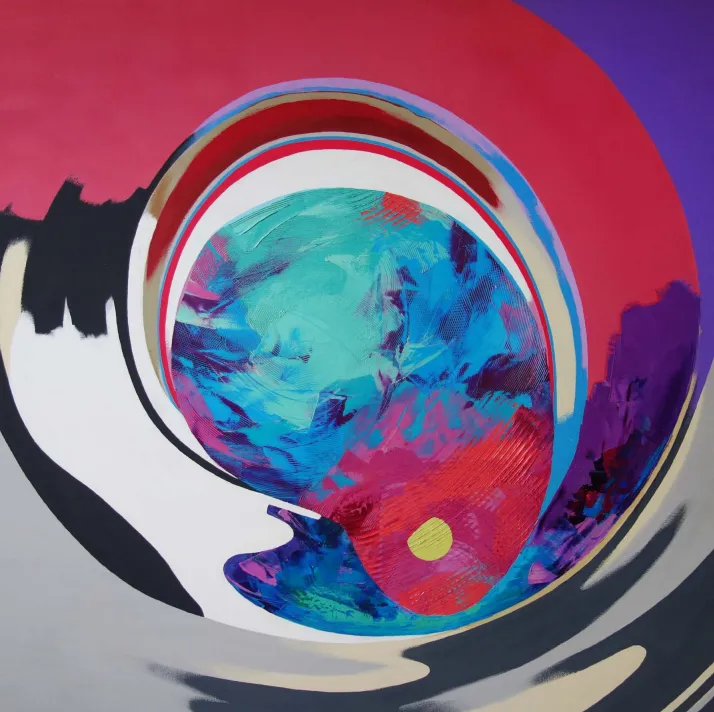
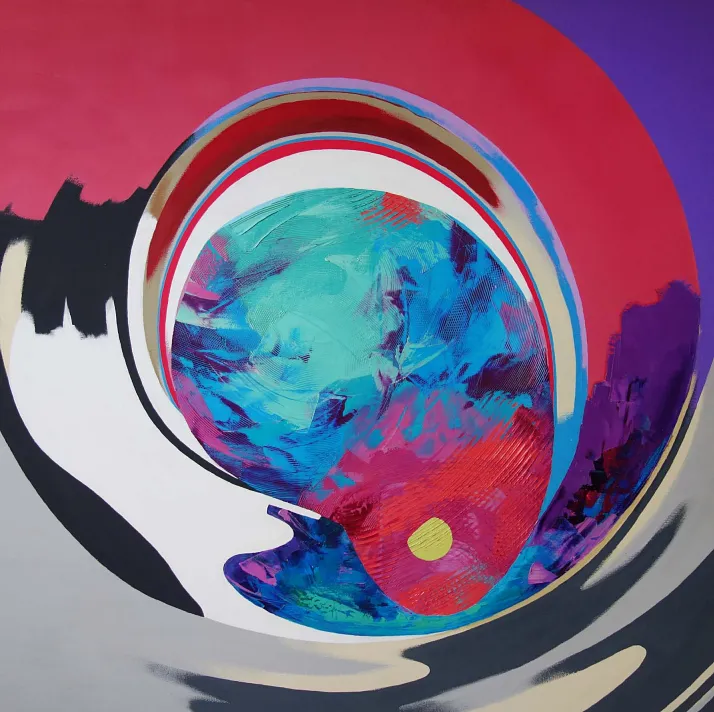
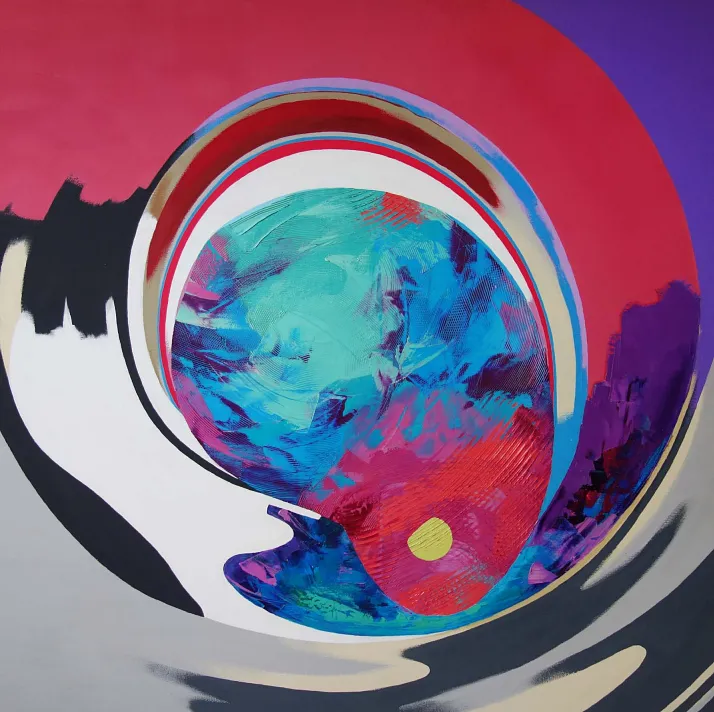
Primary Movement II continues the exploration of the moment of creation, but here the primal impulse begins to acquire a more defined structure. The composition is organised around a large rounded form — a kind of space within which something new begins to emerge.
The blue-turquoise mass appears as fluid matter, still lacking definitive boundaries. Within it, an intense crimson-red fragment of energy emerges, accentuated by a small yellow form. This becomes a point of concentration — as though it were the first impulse around which an undefined environment begins to organise itself.
Concentric arcs and large black, white, and grey planes play a particularly important role. Their dynamic silhouettes encompass the central structure, directing movement inwards while simultaneously drawing it into a circular motion. This creates a sense of a force field in which form does not simply exist, but comes into being through the interaction of energy, matter, and space.
The contrast between the expressive, open brushstrokes at the centre and the more clearly defined geometric planes surrounding them creates a tension between chaos and order. Here, primal movement emerges as a process of self-organisation — the moment when undefined matter begins to discover its own structure
Buy Primal Movement II — "Prima Motus" Series (2011)
Year
2011
Dimensions
100x100 cm
Materials
mixed media on canvas
Medium
Painting
Series
PRIMA MOTUS
Price
$3000
Shipping cost depends on location
Primary Movement II continues the exploration of the moment of creation, but here the primal impulse begins to acquire a more defined structure. The composition is organised around a large rounded form — a kind of space within which something new begins to emerge.
The blue-turquoise mass appears as fluid matter, still lacking definitive boundaries. Within it, an intense crimson-red fragment of energy emerges, accentuated by a small yellow form. This becomes a point of concentration — as though it were the first impulse around which an undefined environment begins to organise itself.
Concentric arcs and large black, white, and grey planes play a particularly important role. Their dynamic silhouettes encompass the central structure, directing movement inwards while simultaneously drawing it into a circular motion. This creates a sense of a force field in which form does not simply exist, but comes into being through the interaction of energy, matter, and space.
The contrast between the expressive, open brushstrokes at the centre and the more clearly defined geometric planes surrounding them creates a tension between chaos and order. Here, primal movement emerges as a process of self-organisation — the moment when undefined matter begins to discover its own structure
Ask Primal Movement II — "Prima Motus" Series (2011)
Year
2011
Dimensions
100x100 cm
Materials
mixed media on canvas
Medium
Painting
Series
PRIMA MOTUS
Price
$3000
Shipping cost depends on location
Primary Movement II continues the exploration of the moment of creation, but here the primal impulse begins to acquire a more defined structure. The composition is organised around a large rounded form — a kind of space within which something new begins to emerge.
The blue-turquoise mass appears as fluid matter, still lacking definitive boundaries. Within it, an intense crimson-red fragment of energy emerges, accentuated by a small yellow form. This becomes a point of concentration — as though it were the first impulse around which an undefined environment begins to organise itself.
Concentric arcs and large black, white, and grey planes play a particularly important role. Their dynamic silhouettes encompass the central structure, directing movement inwards while simultaneously drawing it into a circular motion. This creates a sense of a force field in which form does not simply exist, but comes into being through the interaction of energy, matter, and space.
The contrast between the expressive, open brushstrokes at the centre and the more clearly defined geometric planes surrounding them creates a tension between chaos and order. Here, primal movement emerges as a process of self-organisation — the moment when undefined matter begins to discover its own structure