Primary Movement V — "Prima Motus" Series (2026)
Year
2026
Materials
acrylic on canvas
Medium
Painting
Series
PRIMA MOTUS
Price
$3000
Shipping cost depends on location
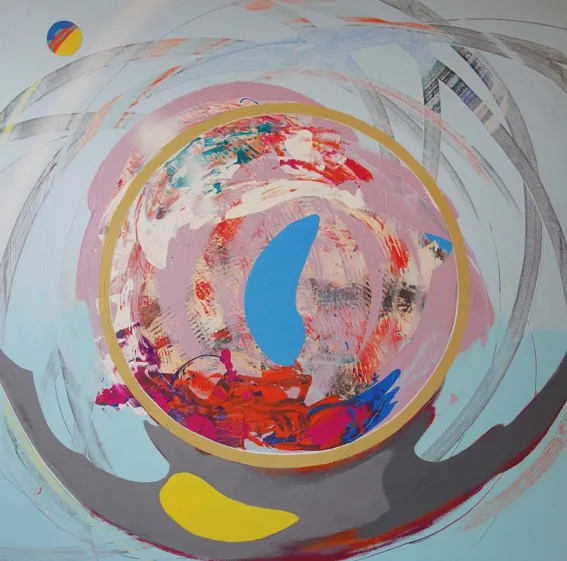
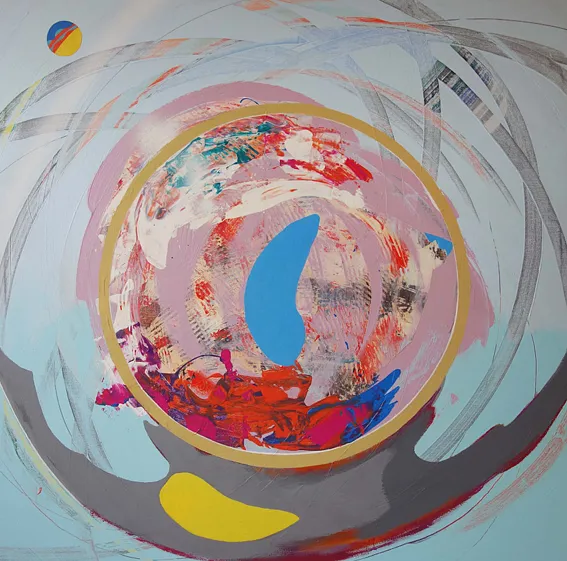
Primary Movement V continues the exploration of the process of creation, shifting its focus from the division of the primal form to the formation of a new internal order. At the centre of the composition, a large rounded structure emerges — a kind of environment in which heterogeneous fragments of matter interact, overlap, and gradually form a new whole.
Within this form, painterly, textured masses coexist with flat, clearly defined fields of colour. A blue fragment at the centre becomes a distinct visual sign amid the complex movement of pink, red, white, and turquoise layers. They no longer constitute a single homogeneous substance — each element seems to acquire its own nature while remaining part of a shared structure.
Around the central core unfolds a system of broad arcs and fine lines. Grey, white, and translucent trajectories create a sense of movement extending far beyond the boundaries of the form itself. The composition seems to capture not a static object, but a field of interaction in which internal processes continue into the surrounding space.
The small coloured sphere in the upper part of the composition takes on particular significance. Detached from the central structure, it appears as an autonomous fragment — the result of a division that has already taken place, now capable of its own movement and existence.
Primary Movement V captures the moment when newly formed matter begins to establish its own system of relationships. Creation here is no longer merely the emergence or division of form — it becomes a process of organising a more complex environment capable of generating new autonomous structures.
Buy Primary Movement V — "Prima Motus" Series (2026)
Year
2026
Materials
acrylic on canvas
Medium
Painting
Series
PRIMA MOTUS
Price
$3000
Shipping cost depends on location
Primary Movement V continues the exploration of the process of creation, shifting its focus from the division of the primal form to the formation of a new internal order. At the centre of the composition, a large rounded structure emerges — a kind of environment in which heterogeneous fragments of matter interact, overlap, and gradually form a new whole.
Within this form, painterly, textured masses coexist with flat, clearly defined fields of colour. A blue fragment at the centre becomes a distinct visual sign amid the complex movement of pink, red, white, and turquoise layers. They no longer constitute a single homogeneous substance — each element seems to acquire its own nature while remaining part of a shared structure.
Around the central core unfolds a system of broad arcs and fine lines. Grey, white, and translucent trajectories create a sense of movement extending far beyond the boundaries of the form itself. The composition seems to capture not a static object, but a field of interaction in which internal processes continue into the surrounding space.
The small coloured sphere in the upper part of the composition takes on particular significance. Detached from the central structure, it appears as an autonomous fragment — the result of a division that has already taken place, now capable of its own movement and existence.
Primary Movement V captures the moment when newly formed matter begins to establish its own system of relationships. Creation here is no longer merely the emergence or division of form — it becomes a process of organising a more complex environment capable of generating new autonomous structures.
Ask Primary Movement V — "Prima Motus" Series (2026)
Year
2026
Materials
acrylic on canvas
Medium
Painting
Series
PRIMA MOTUS
Price
$3000
Shipping cost depends on location
Primary Movement V continues the exploration of the process of creation, shifting its focus from the division of the primal form to the formation of a new internal order. At the centre of the composition, a large rounded structure emerges — a kind of environment in which heterogeneous fragments of matter interact, overlap, and gradually form a new whole.
Within this form, painterly, textured masses coexist with flat, clearly defined fields of colour. A blue fragment at the centre becomes a distinct visual sign amid the complex movement of pink, red, white, and turquoise layers. They no longer constitute a single homogeneous substance — each element seems to acquire its own nature while remaining part of a shared structure.
Around the central core unfolds a system of broad arcs and fine lines. Grey, white, and translucent trajectories create a sense of movement extending far beyond the boundaries of the form itself. The composition seems to capture not a static object, but a field of interaction in which internal processes continue into the surrounding space.
The small coloured sphere in the upper part of the composition takes on particular significance. Detached from the central structure, it appears as an autonomous fragment — the result of a division that has already taken place, now capable of its own movement and existence.
Primary Movement V captures the moment when newly formed matter begins to establish its own system of relationships. Creation here is no longer merely the emergence or division of form — it becomes a process of organising a more complex environment capable of generating new autonomous structures.