.jpg?locale=en)
New London. Part II. Sigmeister — "Transformation" Series. (2005)
Year
2005
Dimensions
70Х90 см
Materials
acrylic on canvas
Medium
Painting
Series
TRANSFORMATION
Price
$4500
Shipping cost depends on location
90 × 70 cm
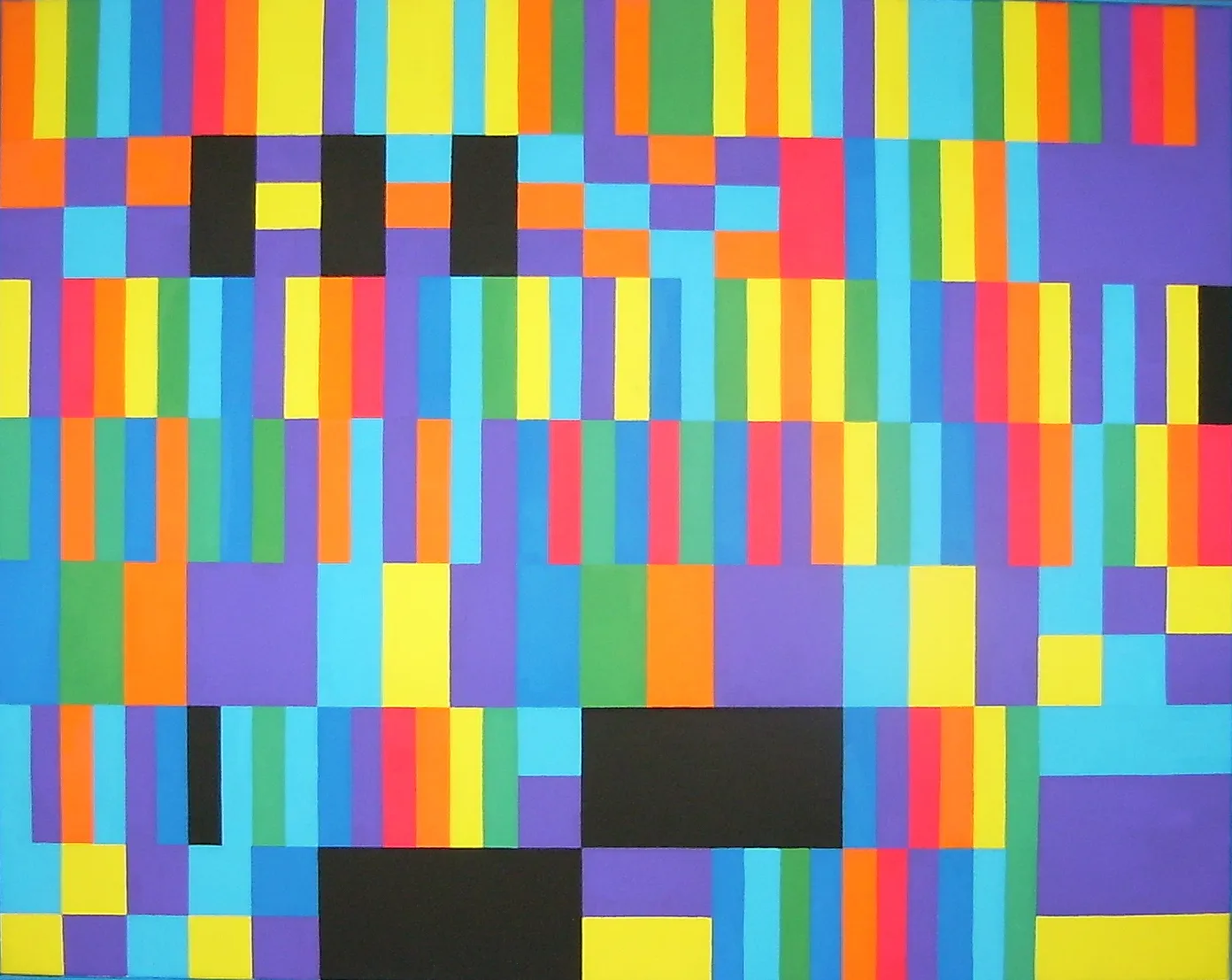
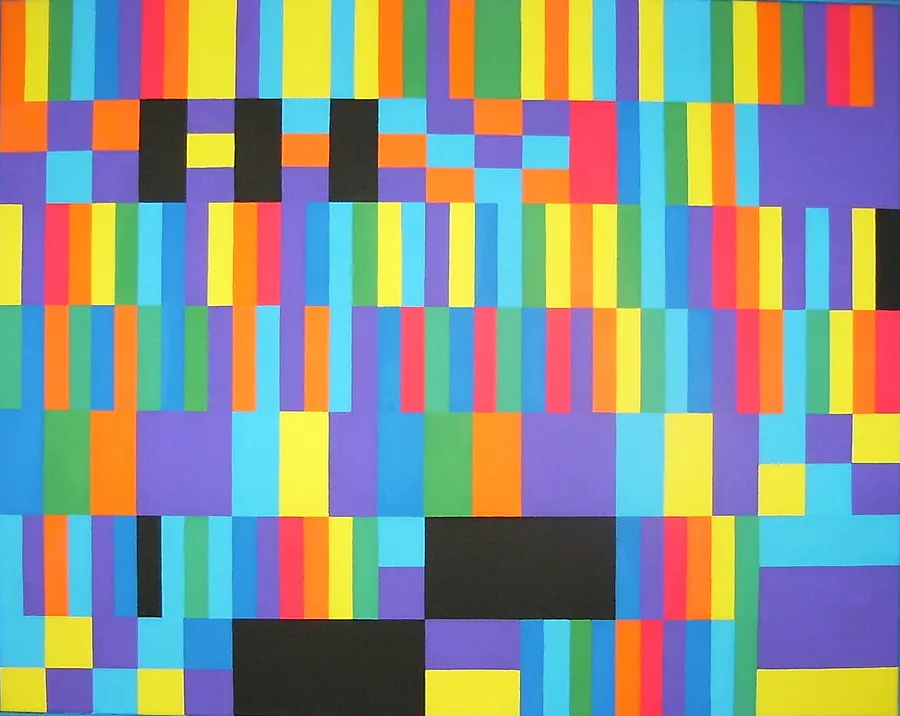
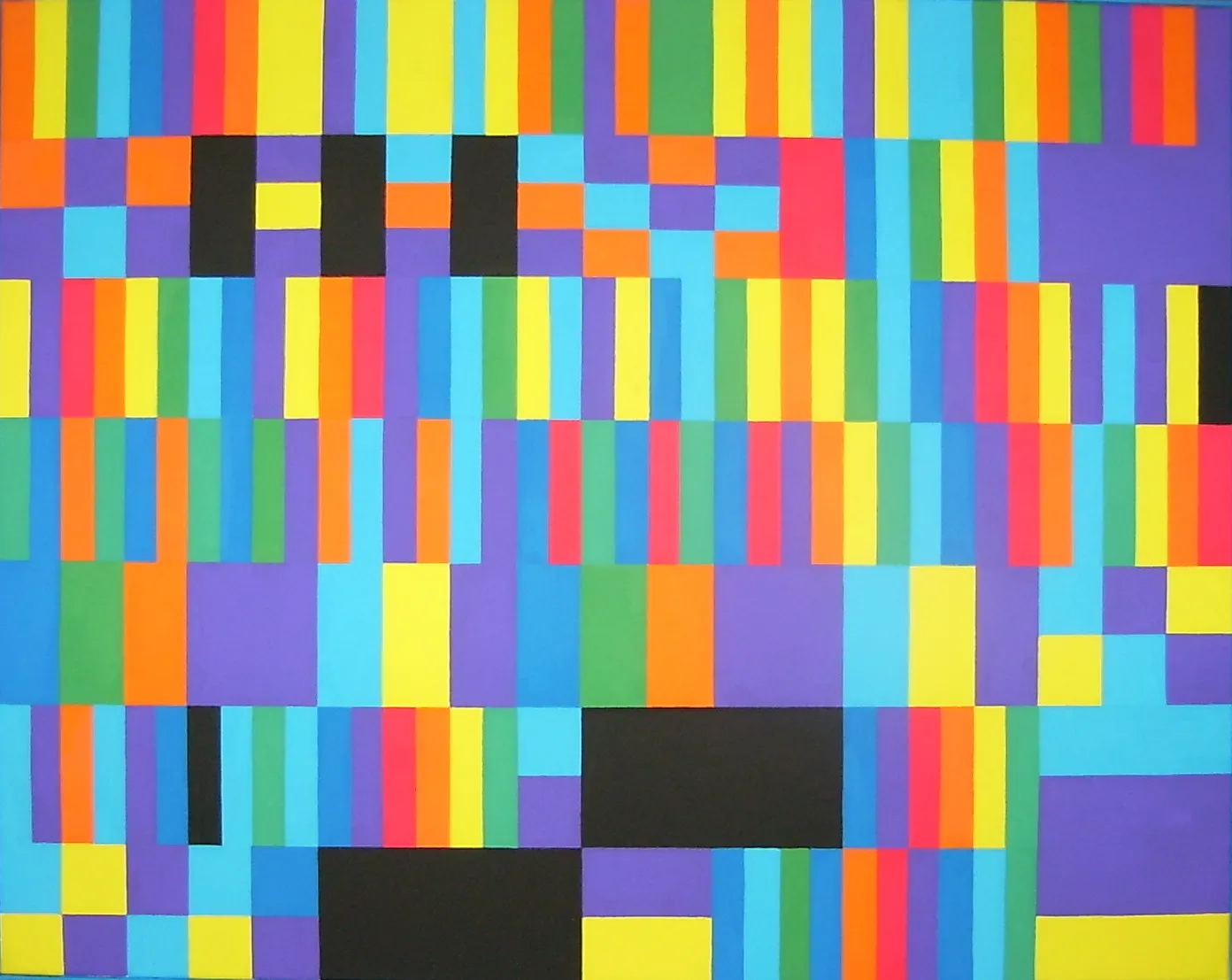
In the second part of New London, the chromatic structure becomes more open and spatial. Vertical sequences of colour retain the principle of musical rhythm, but now interact with larger fields of blue, violet, and black, creating complex relationships between sound and pause, density and space.
The coloured modules vary in width, height, and frequency of repetition, like individual voices within a polyphonic composition. Some rhythms accelerate, while others slow down or are suddenly interrupted. Large black rectangles function as deep pauses — moments of silence necessary for the further development of the chromatic structure.
At the same time, the composition may evoke the experience of a large city: vertical structures, signals of light, movement, and fragments of an architectural environment. Yet, as in the first part, this is not a representation of a specific place, but rather a transformation of the experience of urban space into a rhythm of colour and form.
Together, the two parts of New London can be perceived as a single diptych — two successive movements within one visual score, in which painting approaches the principles of musical composition.
Buy New London. Part II. Sigmeister — "Transformation" Series. (2005)
Year
2005
Dimensions
70Х90 см
Materials
acrylic on canvas
Medium
Painting
Series
TRANSFORMATION
Price
$4500
Shipping cost depends on location
In the second part of New London, the chromatic structure becomes more open and spatial. Vertical sequences of colour retain the principle of musical rhythm, but now interact with larger fields of blue, violet, and black, creating complex relationships between sound and pause, density and space.
The coloured modules vary in width, height, and frequency of repetition, like individual voices within a polyphonic composition. Some rhythms accelerate, while others slow down or are suddenly interrupted. Large black rectangles function as deep pauses — moments of silence necessary for the further development of the chromatic structure.
At the same time, the composition may evoke the experience of a large city: vertical structures, signals of light, movement, and fragments of an architectural environment. Yet, as in the first part, this is not a representation of a specific place, but rather a transformation of the experience of urban space into a rhythm of colour and form.
Together, the two parts of New London can be perceived as a single diptych — two successive movements within one visual score, in which painting approaches the principles of musical composition.
Ask New London. Part II. Sigmeister — "Transformation" Series. (2005)
Year
2005
Dimensions
70Х90 см
Materials
acrylic on canvas
Medium
Painting
Series
TRANSFORMATION
Price
$4500
Shipping cost depends on location
In the second part of New London, the chromatic structure becomes more open and spatial. Vertical sequences of colour retain the principle of musical rhythm, but now interact with larger fields of blue, violet, and black, creating complex relationships between sound and pause, density and space.
The coloured modules vary in width, height, and frequency of repetition, like individual voices within a polyphonic composition. Some rhythms accelerate, while others slow down or are suddenly interrupted. Large black rectangles function as deep pauses — moments of silence necessary for the further development of the chromatic structure.
At the same time, the composition may evoke the experience of a large city: vertical structures, signals of light, movement, and fragments of an architectural environment. Yet, as in the first part, this is not a representation of a specific place, but rather a transformation of the experience of urban space into a rhythm of colour and form.
Together, the two parts of New London can be perceived as a single diptych — two successive movements within one visual score, in which painting approaches the principles of musical composition.
.jpg?locale=en)