Genesis IV — «Prima Motus" Series (2026)
Year
2026
Dimensions
160х80 см
Materials
mixed media on canvas
Medium
Painting
Series
PRIMA MOTUS
Price
Price on request
80 × 160 cm
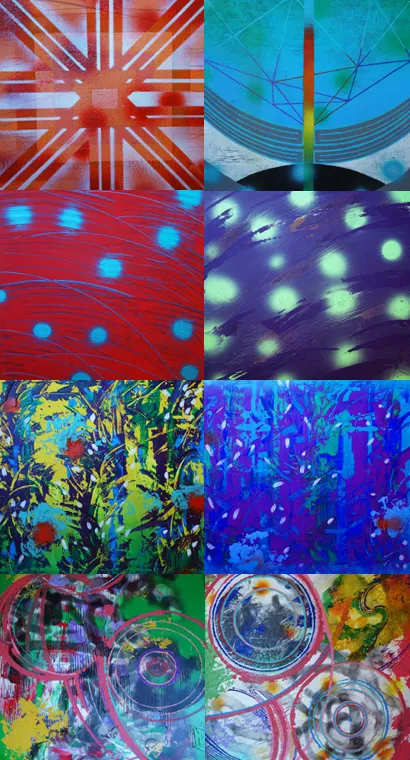
Genesis IV continues the exploration of the process of creation, but here the theme of the transition from an organised structure to a living system becomes particularly pronounced. The composition unfolds sequentially once again: from geometric order in the upper fragments, through the energy of movement, to complex organic and spatial formations below.
The first two fragments resemble diagrams or models of a future structure. Straight lines, symmetry, axes, intersections, and radiating constructions create an ordered field. They may evoke unknown coordinate systems, technical drawings, or signs, yet resist any definitive interpretation. This is not yet an image, but rather a principle through which an image might emerge.
At the next stage, geometry gives way to movement. Red and violet fields become filled with luminous spheres and numerous lines of motion. The point begins to move, the line becomes a path, and the ordered diagram transforms into an energy field.
A sudden transition towards organic complexity follows. Yellow, green, blue, and violet structures expand, intertwine, and overlap. They evoke natural formations, yet remain at the threshold of recognition. Here, it becomes difficult to identify where an individual form begins or ends — it exists as part of a larger environment.
In the final two fragments, circles, orbits, and concentric structures appear. They seem to return the composition to the geometry of its beginning, yet this is now a different geometry — one born within a complex painterly environment. The circle becomes not merely a sign, but a focal point around which different flows and forms interact.
Genesis IV establishes a cycle of transformation: structure → energy → organic environment → new structure. Creation appears here not as a linear progression from the simple to the complex, but as a continuous process of self-organisation in which order gives rise to chaos, and from chaos, order emerges once again.
Buy Genesis IV — «Prima Motus" Series (2026)
Year
2026
Dimensions
160х80 см
Materials
mixed media on canvas
Medium
Painting
Series
PRIMA MOTUS
Price
Price on request
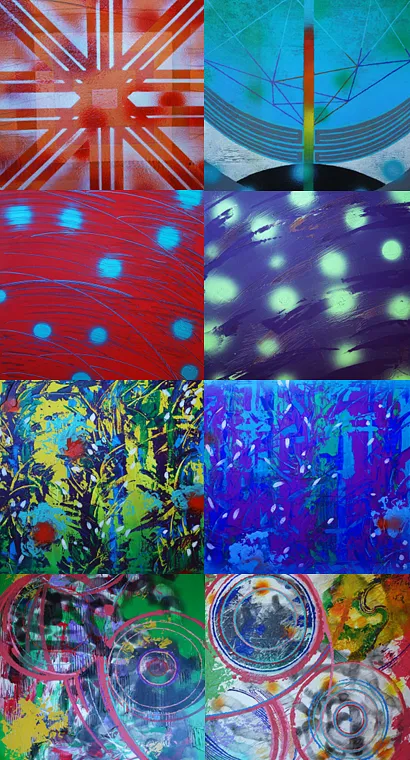
Genesis IV continues the exploration of the process of creation, but here the theme of the transition from an organised structure to a living system becomes particularly pronounced. The composition unfolds sequentially once again: from geometric order in the upper fragments, through the energy of movement, to complex organic and spatial formations below.
The first two fragments resemble diagrams or models of a future structure. Straight lines, symmetry, axes, intersections, and radiating constructions create an ordered field. They may evoke unknown coordinate systems, technical drawings, or signs, yet resist any definitive interpretation. This is not yet an image, but rather a principle through which an image might emerge.
At the next stage, geometry gives way to movement. Red and violet fields become filled with luminous spheres and numerous lines of motion. The point begins to move, the line becomes a path, and the ordered diagram transforms into an energy field.
A sudden transition towards organic complexity follows. Yellow, green, blue, and violet structures expand, intertwine, and overlap. They evoke natural formations, yet remain at the threshold of recognition. Here, it becomes difficult to identify where an individual form begins or ends — it exists as part of a larger environment.
In the final two fragments, circles, orbits, and concentric structures appear. They seem to return the composition to the geometry of its beginning, yet this is now a different geometry — one born within a complex painterly environment. The circle becomes not merely a sign, but a focal point around which different flows and forms interact.
Genesis IV establishes a cycle of transformation: structure → energy → organic environment → new structure. Creation appears here not as a linear progression from the simple to the complex, but as a continuous process of self-organisation in which order gives rise to chaos, and from chaos, order emerges once again.
Ask Genesis IV — «Prima Motus" Series (2026)
Year
2026
Dimensions
160х80 см
Materials
mixed media on canvas
Medium
Painting
Series
PRIMA MOTUS
Price
Price on request
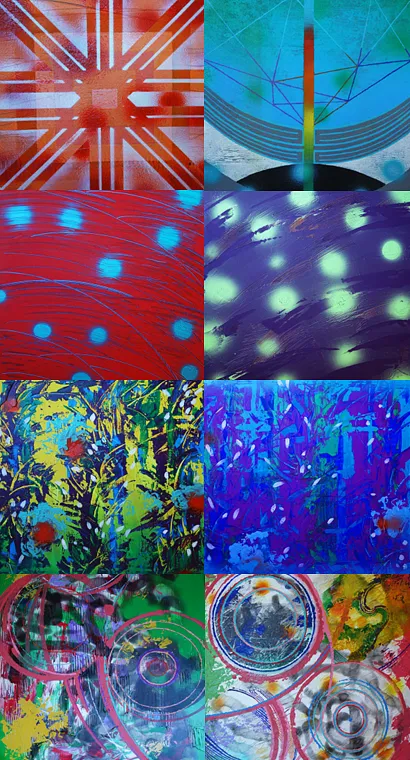
Genesis IV continues the exploration of the process of creation, but here the theme of the transition from an organised structure to a living system becomes particularly pronounced. The composition unfolds sequentially once again: from geometric order in the upper fragments, through the energy of movement, to complex organic and spatial formations below.
The first two fragments resemble diagrams or models of a future structure. Straight lines, symmetry, axes, intersections, and radiating constructions create an ordered field. They may evoke unknown coordinate systems, technical drawings, or signs, yet resist any definitive interpretation. This is not yet an image, but rather a principle through which an image might emerge.
At the next stage, geometry gives way to movement. Red and violet fields become filled with luminous spheres and numerous lines of motion. The point begins to move, the line becomes a path, and the ordered diagram transforms into an energy field.
A sudden transition towards organic complexity follows. Yellow, green, blue, and violet structures expand, intertwine, and overlap. They evoke natural formations, yet remain at the threshold of recognition. Here, it becomes difficult to identify where an individual form begins or ends — it exists as part of a larger environment.
In the final two fragments, circles, orbits, and concentric structures appear. They seem to return the composition to the geometry of its beginning, yet this is now a different geometry — one born within a complex painterly environment. The circle becomes not merely a sign, but a focal point around which different flows and forms interact.
Genesis IV establishes a cycle of transformation: structure → energy → organic environment → new structure. Creation appears here not as a linear progression from the simple to the complex, but as a continuous process of self-organisation in which order gives rise to chaos, and from chaos, order emerges once again.