Genesis II — "Prima Motus" Series (2015)
Year
2015
Dimensions
160x80 cm
Materials
mixed media on canvas
Medium
Painting
Series
PRIMA MOTUS
Price
Price on request
80 × 160 cm
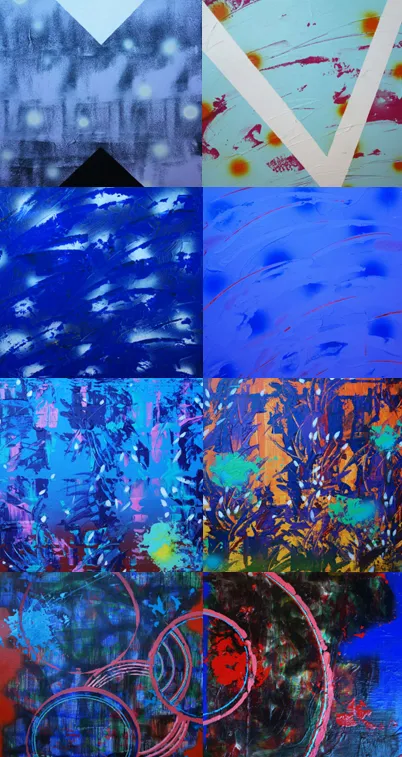
Genesis II continues the exploration of creation as a sequence of transformations, yet here the process takes on a different character. While Genesis can be read as a movement from a primal signal towards the emergence of matter, Genesis II places greater emphasis on the gradual increase in complexity of the environment and the emergence of an internal structure.
The composition consists of eight interconnected fragments. The upper sections are dominated by cool blue fields, points of light, and large geometric signs. White and black enter the painterly space as clearly defined silhouettes — a kind of primal coordinates that establish the direction of subsequent movement.
As the composition unfolds, geometric definition gradually dissolves. Broad blue brushstrokes, fine red lines, and blurred impulses of colour create an environment in which no specific image has yet emerged, but a rhythm of genesis and an inner dynamic can already be sensed. Colour ceases to function merely as a plane and begins to act as energy.
In the central fragments, the painting becomes considerably denser. Blue, violet, pink, orange, and green masses intertwine into structures that evoke natural formations — vegetation, cellular systems, and organic environments. Yet these associations remain open-ended: form exists at the threshold between abstraction and recognition.
In the lower sections, circles and arcs appear — no longer as static geometric elements, but as trajectories of movement and interaction. They enter the dark painterly environment, intersect, and partially extend beyond the boundaries of individual fragments, creating the impression of a system that continues to shape itself.
Genesis II can be understood as a visual model of becoming: from a primal sign and an impulse of light, through movement and the accumulation of energy, towards a complex organic environment. Creation here does not arrive at a definitive form. It remains an open-ended process in which each new state already contains the possibility of the next.
Buy Genesis II — "Prima Motus" Series (2015)
Year
2015
Dimensions
160x80 cm
Materials
mixed media on canvas
Medium
Painting
Series
PRIMA MOTUS
Price
Price on request
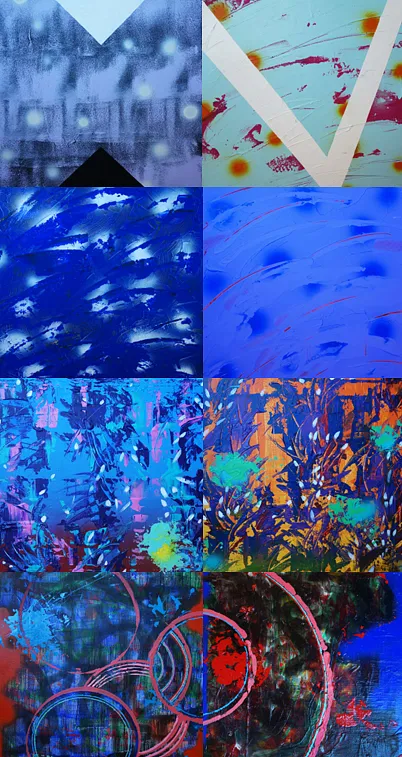
Genesis II continues the exploration of creation as a sequence of transformations, yet here the process takes on a different character. While Genesis can be read as a movement from a primal signal towards the emergence of matter, Genesis II places greater emphasis on the gradual increase in complexity of the environment and the emergence of an internal structure.
The composition consists of eight interconnected fragments. The upper sections are dominated by cool blue fields, points of light, and large geometric signs. White and black enter the painterly space as clearly defined silhouettes — a kind of primal coordinates that establish the direction of subsequent movement.
As the composition unfolds, geometric definition gradually dissolves. Broad blue brushstrokes, fine red lines, and blurred impulses of colour create an environment in which no specific image has yet emerged, but a rhythm of genesis and an inner dynamic can already be sensed. Colour ceases to function merely as a plane and begins to act as energy.
In the central fragments, the painting becomes considerably denser. Blue, violet, pink, orange, and green masses intertwine into structures that evoke natural formations — vegetation, cellular systems, and organic environments. Yet these associations remain open-ended: form exists at the threshold between abstraction and recognition.
In the lower sections, circles and arcs appear — no longer as static geometric elements, but as trajectories of movement and interaction. They enter the dark painterly environment, intersect, and partially extend beyond the boundaries of individual fragments, creating the impression of a system that continues to shape itself.
Genesis II can be understood as a visual model of becoming: from a primal sign and an impulse of light, through movement and the accumulation of energy, towards a complex organic environment. Creation here does not arrive at a definitive form. It remains an open-ended process in which each new state already contains the possibility of the next.
Ask Genesis II — "Prima Motus" Series (2015)
Year
2015
Dimensions
160x80 cm
Materials
mixed media on canvas
Medium
Painting
Series
PRIMA MOTUS
Price
Price on request
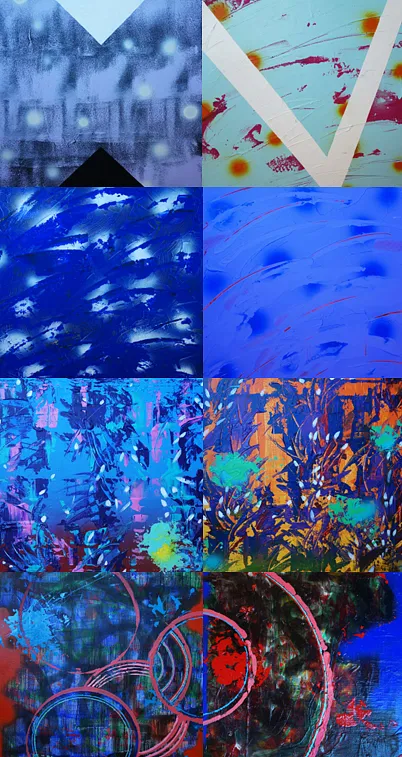
Genesis II continues the exploration of creation as a sequence of transformations, yet here the process takes on a different character. While Genesis can be read as a movement from a primal signal towards the emergence of matter, Genesis II places greater emphasis on the gradual increase in complexity of the environment and the emergence of an internal structure.
The composition consists of eight interconnected fragments. The upper sections are dominated by cool blue fields, points of light, and large geometric signs. White and black enter the painterly space as clearly defined silhouettes — a kind of primal coordinates that establish the direction of subsequent movement.
As the composition unfolds, geometric definition gradually dissolves. Broad blue brushstrokes, fine red lines, and blurred impulses of colour create an environment in which no specific image has yet emerged, but a rhythm of genesis and an inner dynamic can already be sensed. Colour ceases to function merely as a plane and begins to act as energy.
In the central fragments, the painting becomes considerably denser. Blue, violet, pink, orange, and green masses intertwine into structures that evoke natural formations — vegetation, cellular systems, and organic environments. Yet these associations remain open-ended: form exists at the threshold between abstraction and recognition.
In the lower sections, circles and arcs appear — no longer as static geometric elements, but as trajectories of movement and interaction. They enter the dark painterly environment, intersect, and partially extend beyond the boundaries of individual fragments, creating the impression of a system that continues to shape itself.
Genesis II can be understood as a visual model of becoming: from a primal sign and an impulse of light, through movement and the accumulation of energy, towards a complex organic environment. Creation here does not arrive at a definitive form. It remains an open-ended process in which each new state already contains the possibility of the next.