Genesis I — "Prima Motus" Series (2015)
Year
2015
Dimensions
160х80 см
Materials
mixed media on canvas
Medium
Painting
Series
PRIMA MOTUS
Price
Price on request
80 × 160 cm
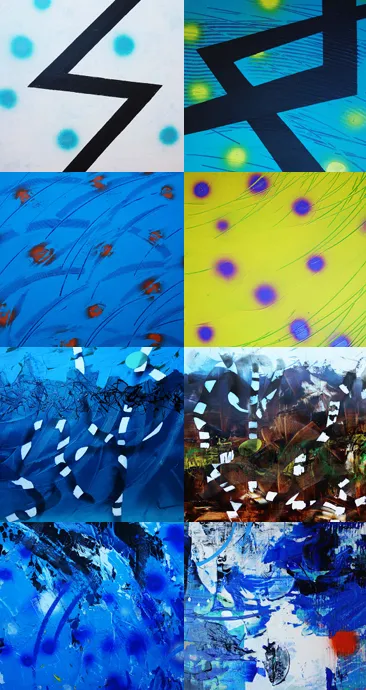
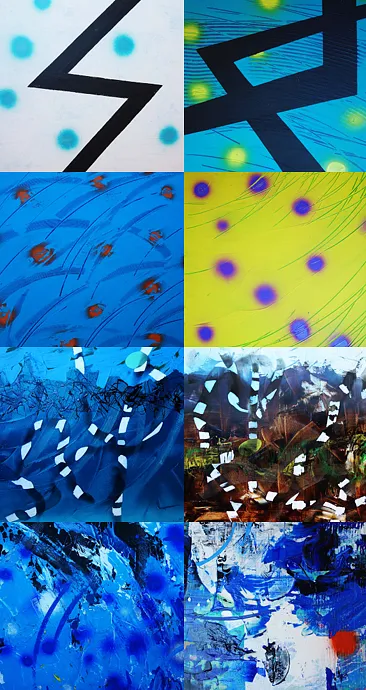
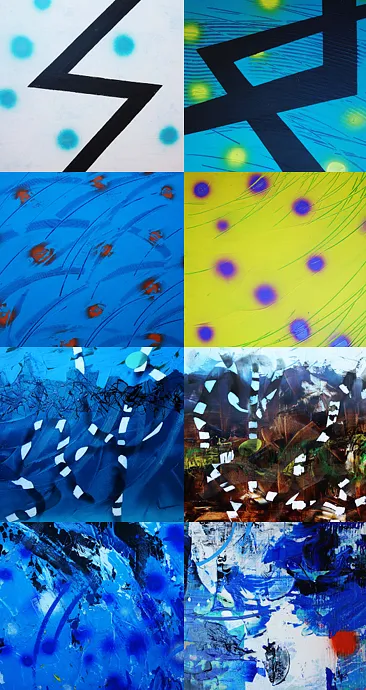
Genesis I explores creation not as a single moment of birth, but as a sequence of states in which energy gradually transforms into matter, space, and form. The work is constructed as a system of individual painterly fragments, each capturing a different phase of this process.
In the upper part of the composition, almost symbolic structures emerge: black angular lines, pure fields of colour, and luminous spheres. They evoke primal signals or impulses — still lacking a specific image, yet already possessing direction and inner tension. As the composition unfolds, the environment becomes increasingly complex: lines multiply, while smaller forms, rhythms, and spatial layers begin to emerge.
In the subsequent fragments, geometric definition gradually breaks down. White planes seem to scatter through space, transforming into a stream of particles, while fragments of the real world begin to appear behind them. The abstract field approaches matter, and the sign approaches the image.
The final sections of the composition shift towards intense gestural painting. Blue, white, and dark masses are no longer governed by strict geometry: they interact, overlap, and transform, creating a new painterly space. What began as an individual impulse gradually becomes a complex system.
The very principle of the composition's construction is significant within the Prima Motus series: creation emerges here as a process of transition — from signal to movement, from movement to structure, from structure to matter, and ultimately to a new image. It is a kind of visual model of genesis, in which each form contains the possibility of the next, and the end of one state becomes the beginning of another.
Buy Genesis I — "Prima Motus" Series (2015)
Year
2015
Dimensions
160х80 см
Materials
mixed media on canvas
Medium
Painting
Series
PRIMA MOTUS
Price
Price on request
Genesis I explores creation not as a single moment of birth, but as a sequence of states in which energy gradually transforms into matter, space, and form. The work is constructed as a system of individual painterly fragments, each capturing a different phase of this process.
In the upper part of the composition, almost symbolic structures emerge: black angular lines, pure fields of colour, and luminous spheres. They evoke primal signals or impulses — still lacking a specific image, yet already possessing direction and inner tension. As the composition unfolds, the environment becomes increasingly complex: lines multiply, while smaller forms, rhythms, and spatial layers begin to emerge.
In the subsequent fragments, geometric definition gradually breaks down. White planes seem to scatter through space, transforming into a stream of particles, while fragments of the real world begin to appear behind them. The abstract field approaches matter, and the sign approaches the image.
The final sections of the composition shift towards intense gestural painting. Blue, white, and dark masses are no longer governed by strict geometry: they interact, overlap, and transform, creating a new painterly space. What began as an individual impulse gradually becomes a complex system.
The very principle of the composition's construction is significant within the Prima Motus series: creation emerges here as a process of transition — from signal to movement, from movement to structure, from structure to matter, and ultimately to a new image. It is a kind of visual model of genesis, in which each form contains the possibility of the next, and the end of one state becomes the beginning of another.
Ask Genesis I — "Prima Motus" Series (2015)
Year
2015
Dimensions
160х80 см
Materials
mixed media on canvas
Medium
Painting
Series
PRIMA MOTUS
Price
Price on request
Genesis I explores creation not as a single moment of birth, but as a sequence of states in which energy gradually transforms into matter, space, and form. The work is constructed as a system of individual painterly fragments, each capturing a different phase of this process.
In the upper part of the composition, almost symbolic structures emerge: black angular lines, pure fields of colour, and luminous spheres. They evoke primal signals or impulses — still lacking a specific image, yet already possessing direction and inner tension. As the composition unfolds, the environment becomes increasingly complex: lines multiply, while smaller forms, rhythms, and spatial layers begin to emerge.
In the subsequent fragments, geometric definition gradually breaks down. White planes seem to scatter through space, transforming into a stream of particles, while fragments of the real world begin to appear behind them. The abstract field approaches matter, and the sign approaches the image.
The final sections of the composition shift towards intense gestural painting. Blue, white, and dark masses are no longer governed by strict geometry: they interact, overlap, and transform, creating a new painterly space. What began as an individual impulse gradually becomes a complex system.
The very principle of the composition's construction is significant within the Prima Motus series: creation emerges here as a process of transition — from signal to movement, from movement to structure, from structure to matter, and ultimately to a new image. It is a kind of visual model of genesis, in which each form contains the possibility of the next, and the end of one state becomes the beginning of another.